

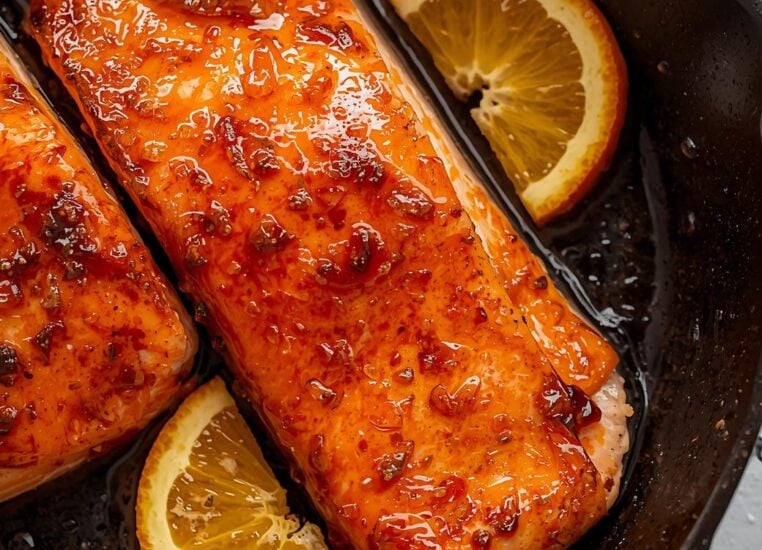
Orange glazed salmon delivers the taste and presentation of a restaurant dish in 25 minutes. Fresh salmon fillets are topped with a bright, caramelized orange glaze that cuts through the richness of the fish.
The dish looks elegant enough for guests but simple enough for a weeknight. One pan holds everything, salmon, vegetables, and the glaze that cooks down while the fish bakes.
Orange Glazed Salmon
The acidity in fresh orange juice balances the fat in salmon without overpowering it. Brown sugar in the glaze caramelizes in the oven, creating a crust that seals in moisture. High heat ensures the exterior develops flavor while the interior stays tender. Most home cooks either undercook salmon (leaving it rubbery) or overcook it (turning it dry). This recipe eliminates guesswork with a visual and temperature-based doneness test.
The glaze comes together from pantry staples, orange juice, brown sugar, soy sauce, garlic, and ginger. No special ingredients. No technique beyond whisking.
Ingredients You Need
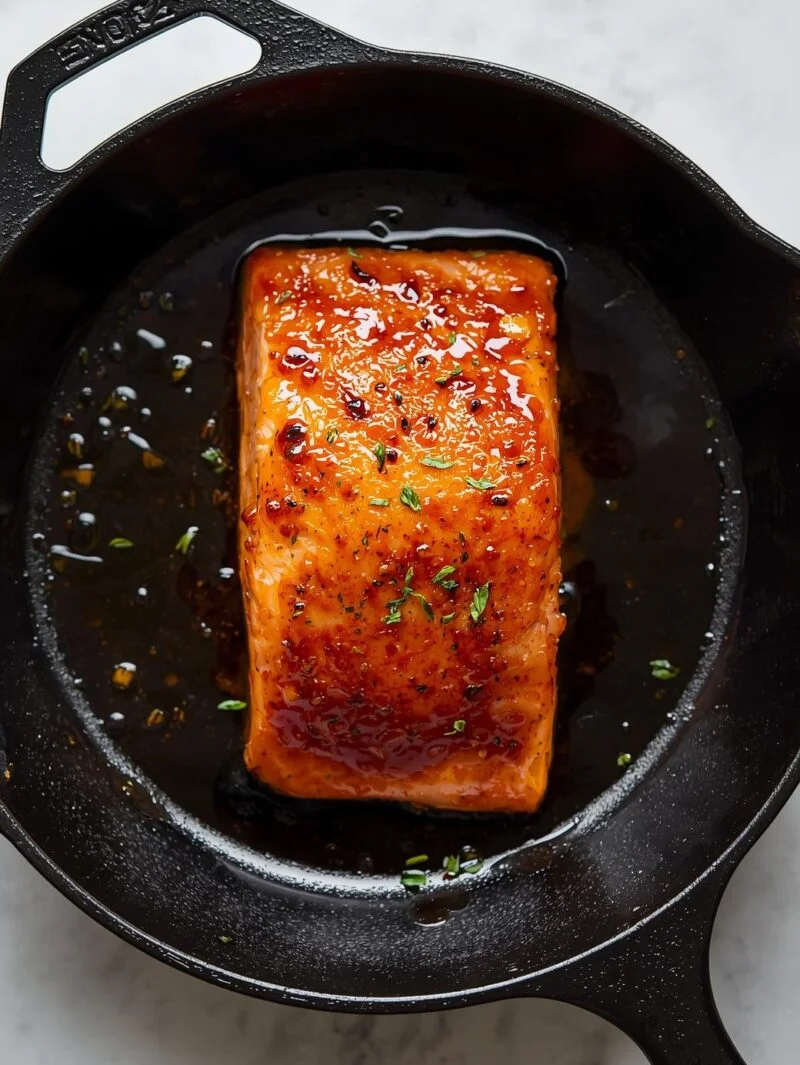
For the Salmon and Glaze (Serves 4)
- 4 salmon fillets (6 ounces each, skin-on or skinless)
- ⅔ cup fresh orange juice (about 3 medium oranges; bottled works)
- ¼ cup soy sauce
- 3 tablespoons brown sugar
- 2 tablespoons honey
- 3 garlic cloves, minced
- 1 tablespoon fresh ginger, minced (or ½ teaspoon ground ginger)
- 2 teaspoons cornstarch
- 2 tablespoons water
- 1 tablespoon sesame oil
- 2 tablespoons olive oil
- Salt and black pepper to taste
- Zest of 1 orange (optional but recommended)
- Red pepper flakes (pinch, optional)
For Roasting Vegetables (Optional but Recommended)
- 1 pound broccoli florets or asparagus
- 1 tablespoon olive oil
- Salt and pepper to taste
Garnish
- 2 green onions, sliced
- Sesame seeds
- Orange slices (optional)
Equipment Notes
You’ll need one large sheet pan (13×18 inches) or two smaller ones. Line with parchment paper or aluminum foil for easy cleanup. Have an instant-read meat thermometer on hand, this is the most reliable way to ensure perfectly cooked salmon.
Step-by-Step Instructions
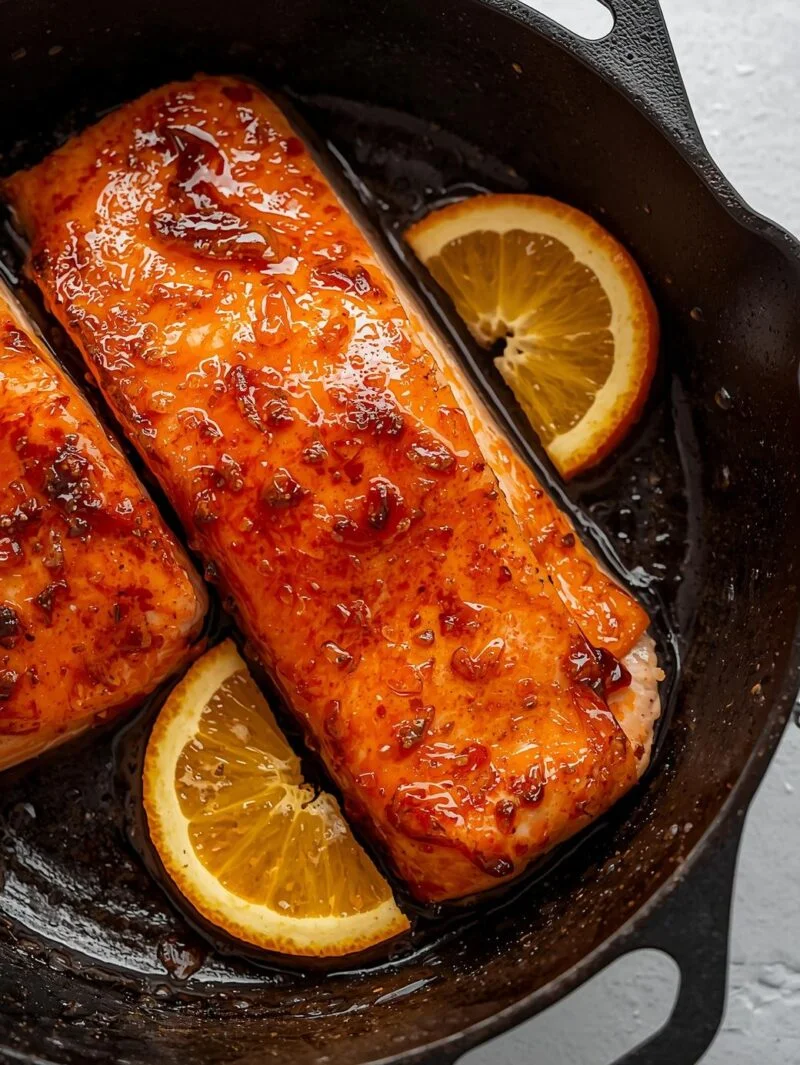
Step 1: Prepare the Glaze (5 minutes)
In a small bowl, whisk together orange juice, soy sauce, brown sugar, honey, minced garlic, and minced ginger. The mixture should smell bright and aromatic.
In another small bowl, mix cornstarch and water to create a slurry. Set aside.
The glaze base needs the slurry to thicken, without it, the glaze stays thin and won’t coat the salmon properly. Cornstarch creates a glossy finish that looks restaurant-quality.
Step 2: Prepare the Pan and Preheat (3 minutes)
Preheat your oven to 425°F. Line a large sheet pan with parchment paper or foil.
Pat salmon fillets dry with paper towels. Moisture on the surface prevents browning and creates steam instead of a crust.
Step 3: Season and Sear (5 minutes)
Season salmon fillets on both sides with salt and pepper. Heat 2 tablespoons olive oil in a large oven-safe skillet over medium-high heat until it shimmers.
Once the oil is hot, place salmon skin-side up in the skillet. Sear for 2–3 minutes without moving until the bottom develops a golden crust. Do not flip the salmon.
Why not flip: Salmon cooks primarily from the oven’s heat after this searing step. The initial sear creates flavor and seals the exterior. Flipping breaks the crust you just built.
Step 4: Add Vegetables (Optional, 2 minutes)
If using broccoli or asparagus, toss with 1 tablespoon olive oil, salt, and pepper. Arrange on the sheet pan around the salmon (if using a sheet pan instead of skillet). If cooking in a skillet, set vegetables aside to roast separately on another pan, or skip them.
For the skillet method, the salmon and glaze stay in the skillet; vegetables go on a separate sheet pan at this point.
Step 5: Build the Glaze (2 minutes)
Pour the orange glaze base over the salmon in the skillet (or transfer salmon to the sheet pan and pour glaze over). Drizzle with 1 tablespoon sesame oil.
If the vegetables are on the same pan, arrange them so they’re not covered by glaze, they roast in the residual heat and pan moisture.
Step 6: Into the Oven (12–15 minutes)
Place the skillet (if oven-safe) or sheet pan in the preheated 425°F oven. Bake for 12–15 minutes.
The salmon is done when it reaches an internal temperature of 145°F at the thickest part, measured with an instant-read thermometer. At this temperature, the fish is moist and tender. Overcooking to 160°F produces dry salmon.
Visual cue: The flesh should flake easily with a fork and appear opaque throughout, with no translucent center.
Step 7: Thicken the Glaze (2 minutes)
Remove from oven. The glaze should be thin and bubbly around the salmon. Stir the cornstarch slurry to reactivate it, then pour it into the pan with the glaze. Stir gently to coat the salmon evenly.
Return to the oven for 2 minutes until the glaze thickens and coats the salmon in a glossy layer.
Alternatively, you can thicken the glaze on the stovetop: transfer the pan to a burner over medium heat, stir in the cornstarch slurry, and cook for 1 minute while stirring constantly.
Step 8: Finish and Garnish (1 minute)
Remove from oven. Sprinkle with orange zest (if using), sliced green onions, and sesame seeds. Add a pinch of red pepper flakes if desired.
Serve immediately with the glaze spooned over the salmon.
Salmon Selection and Preparation
Quality matters. Ask your fishmonger for wild-caught salmon if possible. It has more omega-3 fatty acids and firmer texture. Farm-raised salmon works fine and costs less.
Thickness: Fillets between ¾ inch and 1 inch thick cook evenly. Thinner fillets dry out quickly; thicker ones cook unevenly.
Fresh vs. frozen: Thaw frozen salmon overnight in the refrigerator. Pat very dry before cooking, thawed salmon releases water.
Skin on or off: Skin-on fillets stay moister during cooking. Skin also provides an attractive presentation if left on. Skinless fillets cook slightly faster (reduce oven time by 1–2 minutes).
Ingredient Substitutions and Variations
| Ingredient | Substitute | Notes |
|---|---|---|
| Fresh orange juice | Bottled orange juice | Works equally well; check for no added sugar |
| Brown sugar | Maple syrup or honey | Use 2 tablespoons instead of 3; slightly less thick glaze |
| Soy sauce | Tamari or coconut aminos | Both are gluten-free; tamari has deeper flavor |
| Sesame oil | Olive oil | Loses nutty flavor but still works |
| Fresh ginger | Ground ginger | Use ½ teaspoon; more concentrated flavor |
| Orange juice + honey | Miso + orange juice | Use 1 tablespoon white miso + ⅔ cup OJ; earthier glaze |
| Broccoli/asparagus | Green beans or bok choy | Same cooking method; adjust roast time by 2–3 minutes |
| Salmon fillets | Salmon steaks (center cuts) | Same cooking time; more bone in the center |
| Salmon | Halibut or cod | White fish cooks faster; reduce oven time to 10–12 minutes |
Spice and Flavor Level Adjustments
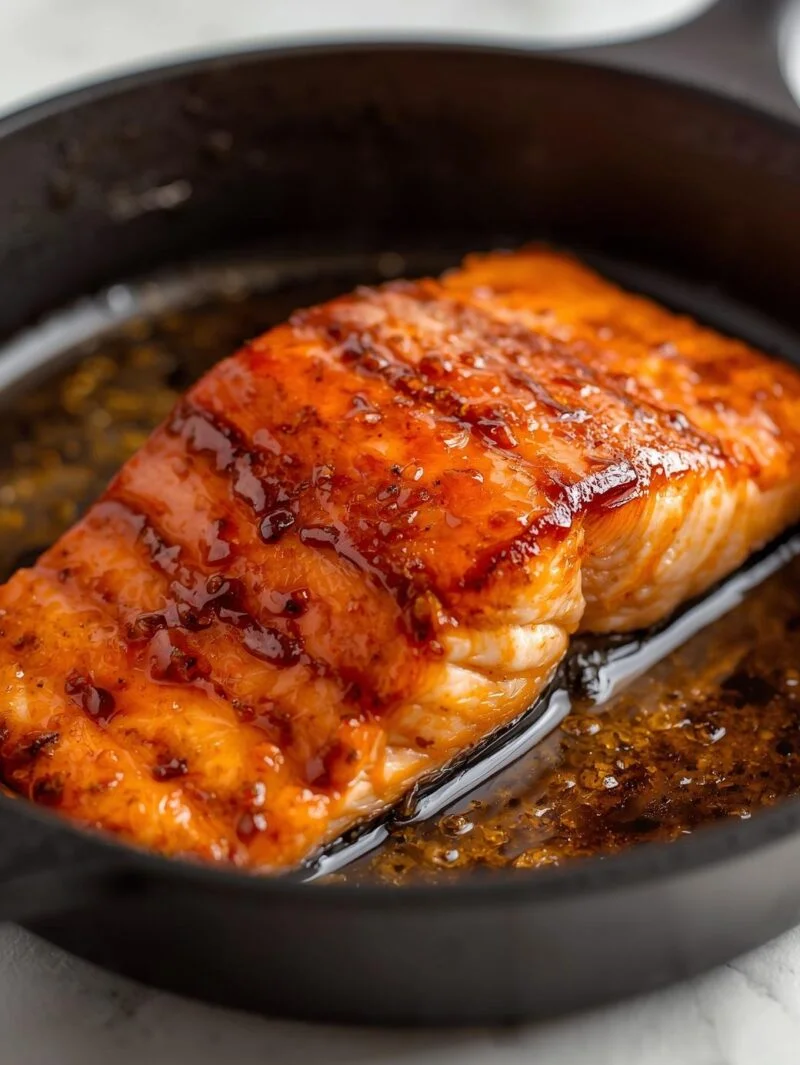
The recipe as written is balanced, bright from orange and ginger, savory from soy and garlic, with a hint of sweetness.
Milder version: Reduce ginger to ½ teaspoon and omit red pepper flakes.
More ginger flavor: Use 1.5 tablespoons fresh ginger or 1 teaspoon ground ginger.
Spicy version: Add ¼ teaspoon cayenne pepper and ½ teaspoon red pepper flakes.
Asian-inspired twist: Add 1 tablespoon rice vinegar and ½ teaspoon Sriracha to the glaze base.
Herb-forward: Add 1 tablespoon fresh cilantro or 2 teaspoons fresh thyme to the glaze.
Side Dish Pairings
Salmon is rich, so pair it with bright, light sides.
Roasted vegetables: Broccoli, asparagus, green beans, or baby bok choy seasoned with salt, pepper, and sesame oil.
Grains: Coconut rice, jasmine rice, or wild rice soak up the excess glaze beautifully.
Salads: Arugula with lemon vinaigrette or mixed greens with sesame ginger dressing balance the richness of the salmon.
Starch: Roasted fingerling potatoes or sweet potato wedges add substance without heaviness.
Asian noodles: Soba noodles tossed with sesame oil and soy sauce provide a complementary texture and flavor.
Storage and Leftovers
Refrigerator: Store cooled salmon in an airtight container for 3–4 days. Reheat gently in a 300°F oven for 5–8 minutes to avoid drying it out. Cold salmon is also delicious on salads or in grain bowls.
Freezer: Wrapped tightly, cooked salmon freezes for up to 3 months. Thaw overnight in the refrigerator before reheating.
Leftover glaze: Store in a glass container for up to 1 week. Use on roasted vegetables, drizzle over rice, or brush on grilled fish.
Common Issues
| Problem | Cause | Fix |
|---|---|---|
| Salmon is dry | Overcooked (internal temp above 145°F) | Use thermometer; pull from oven at 143°F (carryover cooking raises it 2 degrees) |
| Glaze is too thin | Cornstarch slurry not added or mixed properly | Stir slurry before adding; ensure it’s mixed, not separated |
| Glaze burns on edges | Oven temperature too high | Reduce to 400°F; tent with foil if browning too fast |
| Salmon sticks to pan | Insufficient oil or oil not hot enough | Use parchment paper; ensure oil shimmers before adding salmon |
| Flesh is pale (undercooked) | Oven temperature too low or fish started too cold | Verify oven temp with thermometer; let salmon reach room temp for 10 minutes before cooking |
| Glaze slides off salmon | Not thickened enough or too much liquid | Reduce sauce by simmering 2 minutes before adding cornstarch; stir slurry thoroughly |
| Orange flavor is too strong | Too much orange juice or acidic juice | Use only ⅔ cup next time; bottled juice is less acidic than fresh |
Nutrition Information (per serving, serves 4)
| Nutrient | Amount |
|---|---|
| Calories | 380 |
| Protein | 36g |
| Fat | 18g |
| Carbohydrates | 16g |
| Omega-3 fatty acids | 2g |
| Fiber | 0g |
(With roasted broccoli: add 30 calories, 3g carbs, 2g fiber per serving.)
Why Oven-Finish Cooking Works
Finishing salmon in the oven instead of cooking it entirely on the stovetop ensures even heat distribution. The oven’s surrounding heat cooks the salmon gently from all sides, while a skillet applies direct heat only to the bottom. This method prevents the overcooked edges and undercooked center that can happen with stovetop-only cooking.
The glaze in the oven also caramelizes slightly, creating a crust that locks in moisture and develops more complex flavor than a glaze made on the stovetop alone.
Making Orange Glazed Salmon for Guests
This recipe impresses without showing effort. Prepare the glaze base (step 1) up to 4 hours ahead. When guests arrive, sear the salmon and finish in the oven. Total cooking time is still under 20 minutes, so you’re not stuck in the kitchen.
For plating: place salmon in the center of the plate, arrange roasted vegetables on one side, and drizzle glaze around the plate. Garnish with green onions and sesame seeds. Serve with lemon wedges or orange slices on the side.
Cost Breakdown
- Salmon fillets (1.5 pounds): $12–18
- Orange juice (fresh or bottled): $1.50
- Pantry items (soy, sugar, honey, ginger, garlic, cornstarch, oil): $2
- Vegetables (optional): $3–5
- Total for 4 servings: $18–27 ($4.50–6.75 per serving)
Restaurant salmon entrees typically cost $22–32 per plate. Making it at home costs one-third the price while tasting better, the fish is fresher and cooked to your exact preference.
Final Notes
Orange glazed salmon is a dinner that satisfies immediately. The bright citrus, savory glaze, and tender fish feel special without demanding technical skill. The entire meal, salmon, vegetables, glaze, cooks in one pan in under 30 minutes.
Make this once on a Wednesday night, and you’ll add it to regular rotation. Make it for guests on a Saturday, and they’ll ask for the recipe. It’s the kind of dish that becomes a signature meal.
Last modified: July 20, 2026
